Author: Elliott-Famularo, Heather

(Via UConn Today) Coding, Creating, and Changing the World

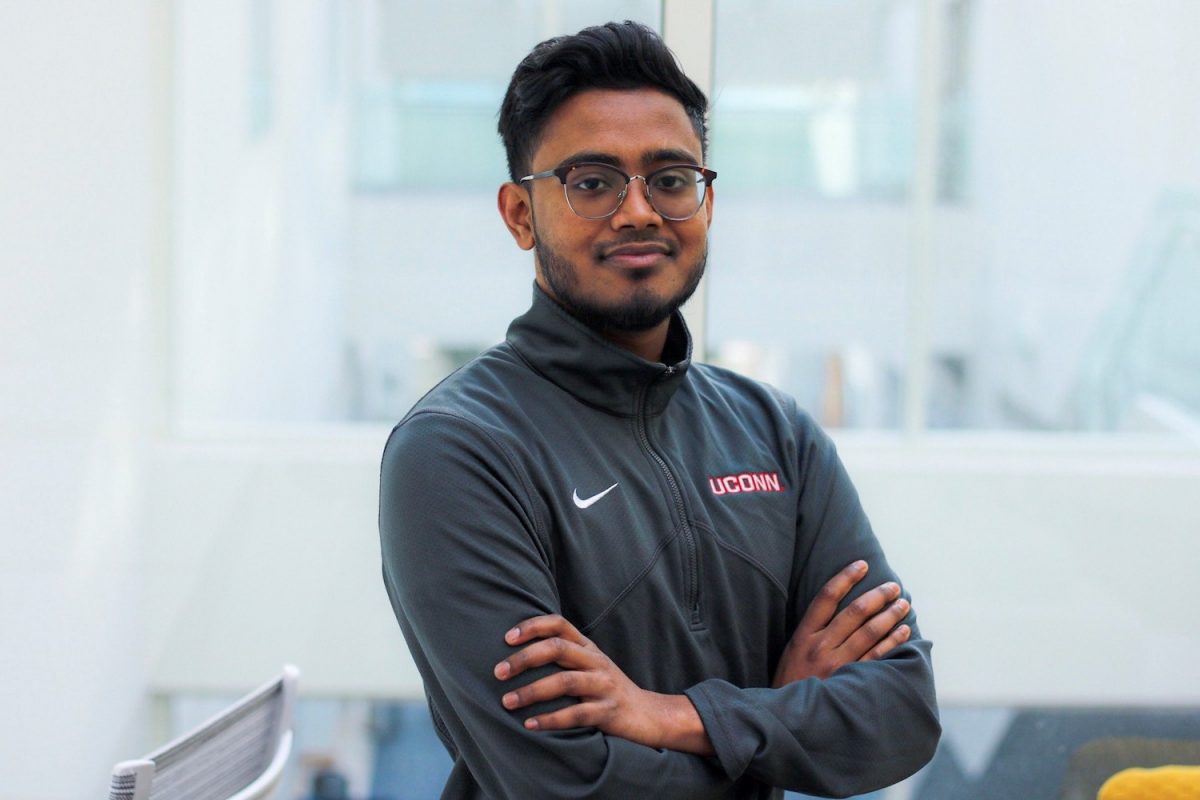
UConn DMD Web/Interactive Media Student, Reaj Uddin at the Stamford campus. (Contributed photo)

 | 

Coding, Creating, and Changing the World

How the Stamford Startup Studio and the Werth Institute helped one student discover the innovator within


Reaj Uddin ‘23 (SFA) remembers studying for a school competition in the seventh grade to try to win $25.

“It was a social studies competition where whoever knows most of the countries in the world gets $25,” he says. “And I studied for like two days in a row, just to know all the countries in the world, just to get that $25 and impress my mom, to make her happy.”

Uddin came close to winning the competition, but ultimately fell just short.

He did not, however, fall short this past October when he brought his idea for a product to help streamline in-home recycling to a pitch night for Get Seeded, a program offered by UConn’s Connecticut Center for Entrepreneurship and Innovation, or CCEI.

He won $1,000 through the pitch night to start developing his company, called EnviGreen Recycling. His original idea was to create a system for sorting, scanning, and crushing recyclables in the home to not only encourage more recycling, but to make the process easier for families like his.

Uddin and his family immigrated to Stamford from Bangladesh in 2009. The youngest of four sons, he was about 10 years old when they arrived in the United States – he had little formal education and spoke no English. He attended remedial schools to learn English before entering public elementary school in Stamford.

In high school, Uddin took a course on web development and found that writing code and building programs appealed to him.

“I didn’t know what to do with my life in high school,” he says. “Then I took this web development course, and it actually made sense to me. I was getting it really quickly and my teachers said, ‘you know, you should try doing this in the future.’ With coding, you can create solutions in almost any field – health, financial services, education technology – and it’s black and white, it’s either coded correctly or incorrectly. You can’t change that, and I actually like that kind of concept.”

Initially, Uddin didn’t plan on attending UConn, or any other college or university, to pursue a career as a developer. He instead looked at trade schools and enrolled in a 24-month training boot camp program.

But he ultimately changed plans at his parents’ urging and dropped out of the boot camp. He applied, and was accepted, into the School of Fine Arts Digital Media and Design Department’s Web/Interactive Media Design program at UConn Stamford.

“My parents insisted – you’re the only child in our family that has one chance to go to college and make something of yourself,” he says. “My other brothers, they finished high school, but didn’t attend any college. My parents wanted me to be the first one, to change the family, in a way. And bringing them here, having them here, I just don’t want them to work as much they did before. I want to provide for them.”

As a sophomore at UConn, he took an advanced web development course where he learned about using APIs – application programming interfaces, a type of protocol for building and integrating app software – and started using them to build his own apps, a process he found he enjoyed.

One of his apps, still a work in progress, uses Spotify API to develop a playlist based on a listener’s emotions – tell the app if you’re feeling happy or angry, and it will build a playlist to compliment your mood.

“I’m trying to improve it by having the camera on, and it will detect your face and, using AI, know what kind of emotions you’re having,” he says, “and with that emotion, create playlists without you having to type it in. You know, sometimes you don’t know what you’re feeling.”

Uddin was part of a small group of students selected for an augmented reality class; the group worked together to create a virtual reality education platform to help student learn about human DNA – it was his first experience building a program in virtual reality.

He is also a member of the inaugural cohort of UConn’s Stamford Startup Studio, a one-year co-op style educational experience offered through the Peter J. Werth Institute for Entrepreneurship and Innovation, where he’s worked with his teammates to build a prototype web application to help make planning weekend activities an easier and better experience for friends and family groups. This semester, he’s been training an AI model as part of the development of the app, called WKNDR.

Uddin and two fellow Startup Studio cohort members are also working to design a computer keyboard that creates electricity while a user types through use of piezoelectric crystals.

“When you press on the keys, the crystals crush and form mechanical energy or electric current,” he says, “which can be stored and then can be used to charge your phone, laptops, anything you want.”
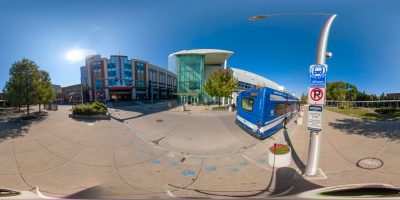
A exterior panoramic view of the Stamford Campus on Oct. 9, 2020. (Peter Morenus/UConn Photo)

It’s a huge shift for Uddin, who describes himself as an introvert and says he’s never thought of himself as an entrepreneur.

“It’s been such a great experience to watch Reaj grow and really transform throughout the past two semesters,” says Tara Watrous ‘18 (CLAS), the Werth Institute’s Head of Entrepreneurial Transformation and the co-founder and director of the Stamford Startup Studio. “What does life-transformative education look like at Werth? It looks like Reaj! His success story is the reason the Werth Institute works to create authentic life-transformative education experiences. It has been so rewarding to see him flourish.”

Uddin took his recycling startup concept through Traction, a CCEI program designed to help UConn-affiliates build their business model and engage in customer discovery, and he’s currently participating in Accelerate UConn. The concept has pivoted from an in-home product to a solution more broadly aimed at meeting the recycling needs of colleges and universities.

“Coming in, he was not as confident and secure in his abilities, and now he’s going to be interning at a startup in New York City, and he’s working on his own venture,” says Watrous. “He’s pushed himself out of his comfort zone, and I think he’s a great example of what students can achieve when they take the risk and push themselves out their comfort zone.”

For all of his growing success, Uddin hasn’t forgotten his roots – he interviewed for the Stamford Startup Studio while on a visit home to Bangladesh, and he says he hopes to use his entrepreneurial pursuits to contribute to a healthy and sustainable world, particularly for developing countries.

“I want to be a part of a company that contributes to greater change,” he says. “I want to be a part of making the world better than what it is right now.”

He credits the Stamford Startup Studio with helping him develop an entrepreneurial mindset, and for helping him build a network of supportive mentors, advisors, and friends as he sets out on his new ventures.

And though he doesn’t always tell his family members about the projects he’s working on – “they wouldn’t understand what I’m talking about,” he explains – he also credits his family, especially his eldest brother, who he says helped him to have a greater vision for his family and inspired him to think beyond what he thought he might be capable of.

“Back in my home, in Bangladesh, we weren’t as fortunate as we are now. We didn’t live in the most lavish home,” Uddin says. “Part of the American dream includes the opportunity for prosperity and success and making a better version of yourself. My brother managed to thrive towards greater social mobility for our family. He built a new house for us back home and truly motivated me to want to make great achievements. When we went back to Bangladesh to see the house for the first time last year, my parents were in tears. We never imagined that we would have a house like this.”

He continued, “It was very inspirational to see him go through all that. I feel he taught me how to connect with people in a good way and make them make them feel valued. I think that’s the most valuable thing that anyone can do – surround yourself with people you love and take care of them.”


To learn more about entrepreneurial education and opportunities offered through the Werth Institute, visit 
entrepreneurship.uconn.edu.

For more information about venture support opportunities like Get Seeded, Traction, and Accelerate UConn, visit CCEI.uconn.edu.


Original Article via UConn Today: https://today.uconn.edu/2022/03/coding-creating-and-changing-the-world/ 
(via UConn Today) App Supporting Archival Research Continues Development with Community Partnerships

App Supporting Archival Research Continues Development with Community Partnerships

Sourcery aims to provide a one-stop shop for archival document sharing between collecting institutions and researchers.

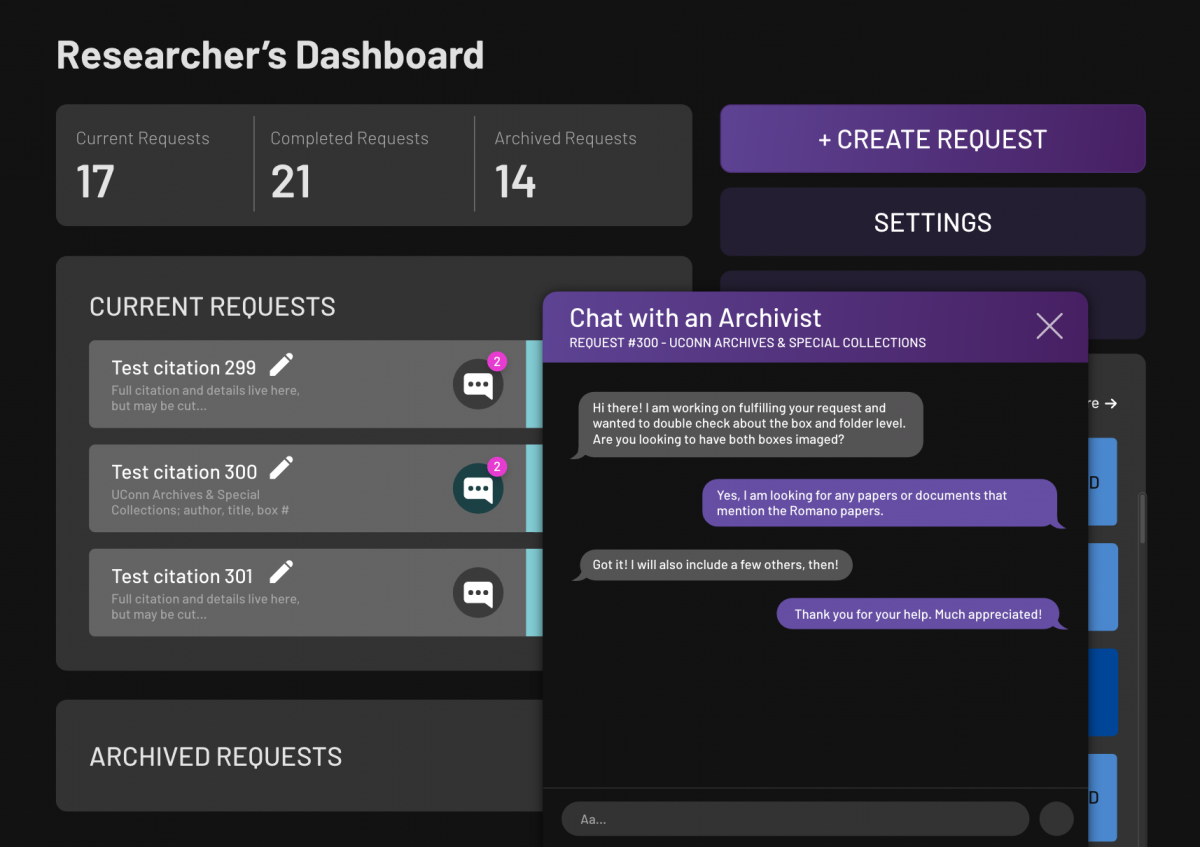
Sourcery’s interface.

Archivists hold in trust centuries of documents and artifacts that historians, anthropologists, literary scholars and more use to uncover new knowledge and understand our collective past.

But all too often, archivists and researchers are navigating workflows, processes, and institutional needs that make it challenging to  communicate effectively. This makes it difficult for archivists to manage document requests and for researchers to get a hold of the materials they need.

The Andrew W. Mellon Foundation has awarded $805,000 to the UConn team behind Sourcery, a software designed to simplify archival document requests.

This new funding will allow the team to develop Sourcery with input from partners at diverse collecting institutions. The team will work with the Hartford Public Library, Northeastern University, UConn Archives and Special Collections, and the Folger Shakespeare Library.

Tom Scheinfeldt, associate professor of history, and Brian Daley assistant professor-in-residence in the Department of Digital Media and Design, co-invented Sourcery in 2020 with the support of Greenhouse Studios.

Sourcery improves the workflow of archivists and librarians by providing a centralized platform for document requests.

Especially during the COVID-19 pandemic, accessing documents at other institutions is a challenge for researchers as they would either need to travel or navigate confusing online request systems. Existing document request systems often result in duplicate requests or multiple archivists working on the same task. Additionally, each institution has their own system for submitting requests, which can be difficult when researchers are trying to navigate multiple processes.

“Sourcery is kind of a middle layer between these closely intertwined but not always very well-communicating groups,” Scheinfeldt says.

With Sourcery, researchers simply log in and submit the citation information for the document they need. If the request is more complex, they can enter a live chat with an archivist in the app.

“We want to make sure the labor of archivists isn’t invisible,” Carly Wanner-Hyde, design technologist at Greenhouse Studios and project lead of Sourcery, says.

With this grant, Sourcery will work with each partner to address specific concerns. For example, the Folger Library deals with rare documents of the English Renaissance and early modern period. Sourcery can help archivists digitize and prioritize cataloguing order of materials so they don’t need to physically handle these fragile documents as often.

The Boston Globe donated their photo morgue to Northeastern’s archives. Soon, whenever the Globe needs an archival photograph, they will use Sourcery to request them.

“Historical research doesn’t happen without archivists and there wouldn’t be much of a role for archivists without historical research,” Scheinfeldt says. “Providing better channels of exchange between the two will improve the work of both.”

Sourcery allows archives to see all active requests on a simple dashboard and manage the requests from there. It also provides archivists with useful data about what documents are being requested, what kind of research they are supporting, and more. Normally, archivists need to collect this data manually.

With Sourcery, researchers can see all their active and past requests on the platform, making it easy to track the status of a request or view previously requested documents.

“One of our big goals now is to make Sourcery a tool for archivists and institutions as much as it’s been a tool for researchers,” Wanner-Hyde says.

Sourcery also integrates with existing systems archivists and researchers use such as ArchivesSpace and Zotero.

Over the next few years, the team will visit conferences of historians and other relevant disciplines to gather community input about Sourcery’s functionality and how to make it more useful to them.

“It’s important to us that this is a product developed by universities for academic researchers,” Scheinfeldt says. “And it’s important for is that we build it with the input of the community. It’s really a community product.”

To learn more about Sourcery, visit sourceryapp.org. If you would like to join us in our testing phase, visit sourceryapp.org/join-us.


See original story via UConn Today: https://today.uconn.edu/2022/02/app-supporting-archival-research-continue-development-with-community-partnerships/ 

(via UConn Today) MFA Exhibits at Benton Showcase Work by DMD, Studio Art Students

MFA Exhibits at Benton Showcase Work by DMD, Studio Art Students

Work that celebrates the collaboration that can take place in the arts

April 21, 2021 | Kenneth Best – UConn Communications
MFA Exhibits at Benton Showcase Work by DMD, Studio Art Students
Work that celebrates the collaboration that can take place in the arts

One of the attractions for enrolling in the Master of Fine Arts in Digital Media & Design (DMD) is the opportunity to work on collaborative projects within the community of creative artists in the School of Fine Arts and beyond.

As a senior in film studies at Chung-Ang University, one of South Korea’s leading private comprehensive research universities, Hongju (Hannah) Lim was becoming interested in exploring 3D animation, and also wanted to work more collaboratively with other visual media. One of her professors told her about UConn’s MFA in DMD.

“DMD brings together multiple disciplines. I thought, if I go there I will have the opportunity to really collaborate with others, and I really did,” says Lim, who is completing the DMD MFA program this spring. “During my graduate study, I’ve worked on developing animations for projection mapping in the lobby of The Bushnell Center for the Performing Arts in Hartford and I’ve also created scientific visualizations in collaboration with researchers in the Department of Marine Sciences and with other DMD students.”

Lim’s MFA thesis project, the 3D animated short film “Ensemble,” is part of the annual Master of Fine Arts Thesis Exhibition at The William Benton Museum of Art, which continues online at The Benton website. The exhibition includes works by graduating Studio Art and DMD MFA students. The Studio Art exhibition, titled “Sour Milk,” features works in photography, mixed media, video, animation, book arts, drawing, printmaking, and painting. The DMD exhibition, titled “Turning Point,” features 2D and 3D animations, UI/UX interactions and designs, digital games, and virtual reality.

Lim’s work “Ensemble” tells the story of a young composer who ignores his outgoing neighbors as he struggles to write music. Ultimately, he learns that the answer to making powerful music is not in his isolation, but in his interactions with neighbors. In the film, the composer leads his neighbors as they play their own instruments, which allows him to complete his new composition. Lim says the film reflects her own experiences.

“In my undergraduate years, people would ask me to spend some time with them, such as traveling to other cities together or going over to their houses to talk and play. However, I said ‘No, I need to study, I need to write my script because I need to concentrate on my school work,’” she says. “After I came here to the USA, I have noticed that for all those years I have missed my chance to learn from people around me. This new environment has helped me to learn by looking around at the people, places, and cultures that surround me. ‘Ensemble’ shows that the more you disconnect from reality, the more likely you will be to miss out on valuable interactions.”

Lim focused on character animation during her MFA work and telling stories about young adults and children. She originally wrote the script for “Ensemble” using only young adult characters but thought the storyline was too serious. She added children and music to the script to make it both lighter and more meaningful.

“Adding characters who are children to my film really conveyed what I want to say through the animation. Children are genuine and innocent, so their silly actions are more easily accepted. I believe the protagonist decided to spend time with the children because instinctively he doesn’t want to hurt their feelings. I decided to make the protagonist a composer, because music is something that can be very personal, but it is also something that you could collaborate on together,” she says. Lim has collaborated with a Korean music producer Ju Won Lee in making music for “Ensemble.”

In addition to Lim, the 2021 DMD MFA Exhibition “Turning Point” features the work of: Emma Atkinson, “when we were,” virtual reality video game; Yucheng Hang, “Cybertown,” interactive educational platform; Wenchao Lou, “Memory-Home-Food,” 2D cooking game; Claudia Nunez, “As You Wish,” 2D animation and pitch bible; and Renoj Varghese, “Microinteractions in Chatbots,” interaction design.

The 2021 MFA Studio Art exhibition “Sour Milk” considers what has soured, creating potential for positive change or harmful destruction. Judith Thorpe, professor of photography and MFA Program director, and Janet Pritchard, professor of photography and MFA Project Seminar coordinator, noted the challenges faced by this year’s MFA class: “Graduating during the time of COVID-19, the class of 2021 has encountered challenges never before imagined. Last year’s class bravely pivoted mid-spring while this year’s class continued facing a year of uncertainty. Blocked from their studios for months, they encountered and mastered alternate means of instruction, conception, production, and fabrication, always adjusting on the fly, driven by their will to create. We celebrate their accomplishments. They challenged themselves, creating new work in unexpected ways that reflect their insights and development over the past three years. Their creative work asks questions and then asks more questions. Their art is visual poetry that will continue to grow and develop after graduate school.”

“Sour Milk” features works by Joseph Caster, photography; Shelby Charlesworth, mixed media installation; Rachel Dickson, photography and video; Paul Michael, books arts and video; and Magdalena Pawlowski, painting and etchings.

An Emerging Artist Talk with the Studio Art MFA candidates will take place on Wednesday April 21 from 3 to 5 p.m. EDT via Zoom. Visit the online exhibition to register.


See original story via UConn Today: https://today.uconn.edu/2021/04/mfa-exhibits-at-benton-showcase-work-by-dmd-studio-art-students/

(Via UConn Today) UConn’s Social Media Analytics Command Center Has 2020 Election Night Covered

UConn’s Social Media Analytics Command Center Has 2020 Election Night Covered

The UConn Social Media Analytics Command Center will be covering the Presidential election with a live broadcast on Tuesday and then will be following up on Twitter when polls start to close around the country.

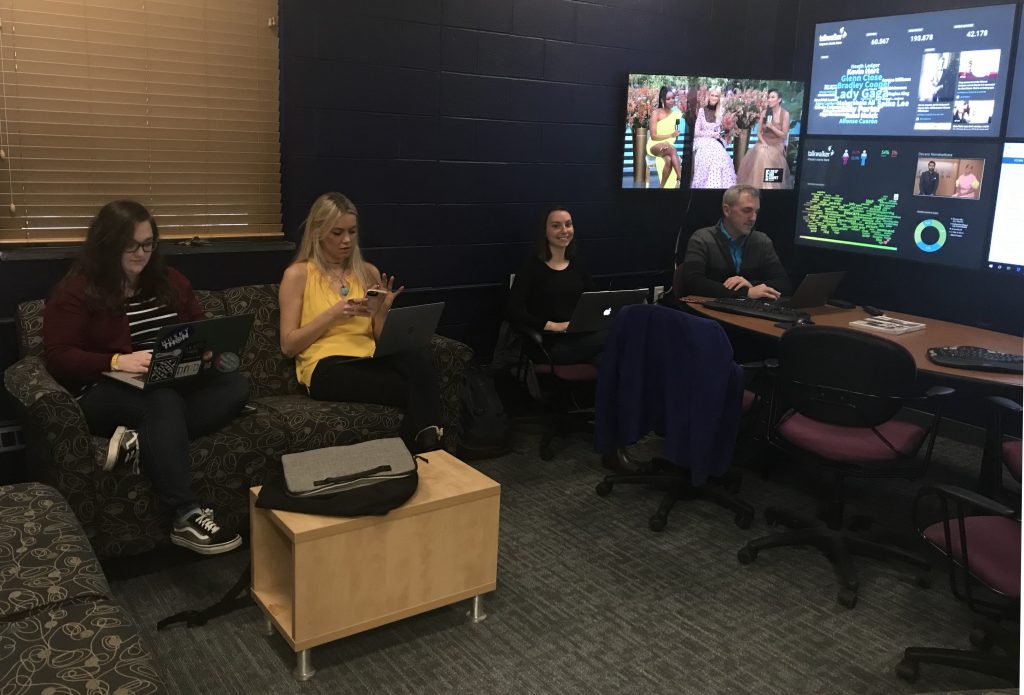
The UConn SMAAC. shown here covering the Oscars, will provide Election Coverage on Tuesday. (photo courtesy of Heather Elliott-Famularo)

he UConn Social Media Analytics Command Center (SMACC) will be covering the presidential election with a live broadcast on Tuesday, Nov. 3 from 5:30 p.m. to 6 p.m., and then will be following up on Twitter when polls start to close around the country.

The half-hour show will be available for all to watch on YouTube, and the Social Media Analytics Command Center can be followed on Twitter@UConnSMACC. The SMACC is part of the UConn Digital Media and Design (DMD) department.

The show will feature digital media design assistant professor in-residence John Murphy, associate professor of political science Jeremy Pressman, and DMD students Ryan Young ’20 (SFA), Christina McDonnell ’20 (SFA), a native of Bolton, and Rosalie Garcia ’20 (SFA), a native of Plainfield.

“The students and I have been tracking the election and all its issues since the Democratic primaries on social media,” says Murphy. “We have a platform that allows us to listen in and pull in publically-available conversations globally on any topic we want. Whether it is a news broadcast, an opinion piece, or a citizen that is out there on social media talking about how they feel regarding this presidential election, we track all that information. We slice it and dice it to come up with insightful analysis.

“Instead of polling people, we listen in on social and digital conversations to hear what people are really saying.”

To learn what kinds of election-related data the SMACC been analyzing, visit:https://smacc.lab.uconn.edu.

The SMACC will also be calling the winners of each state in the presidential election using its Twitter feed as the night goes on.

“When the television networks come on the air, they usually report exit polls and who they think is going to win in certain states as polls close,” says Murphy. “We would like to give a prediction ahead of the networks. When we covered primaries in the spring, we had 25 of 27 called by 5 p.m. based on social media data. We are going to show people how we do that.”

The SMACC has analyzed a number of different events over time, including the Oscars and the NCAA basketball tournament.

“We support brands that hire us and track them and their competitors,” says Murphy. “Anything that is taking place in the world is taking place on digital and social media. So whatever the topic du jour is, we can go out and track it.”


See original story via UConn Today: https://today.uconn.edu/2020/11/uconns-social-media-analytics-command-center-2020-election-night-covered/

(via UConn Today) Student-Launched Platform Supporting Mental Well-Being with Positive Messages from Peers

Student-Launched Platform Supporting Mental Well-Being with Positive Messages from Peers

Two UConn students have launched a social app they hope will make college students around the country feel more connected and supported.

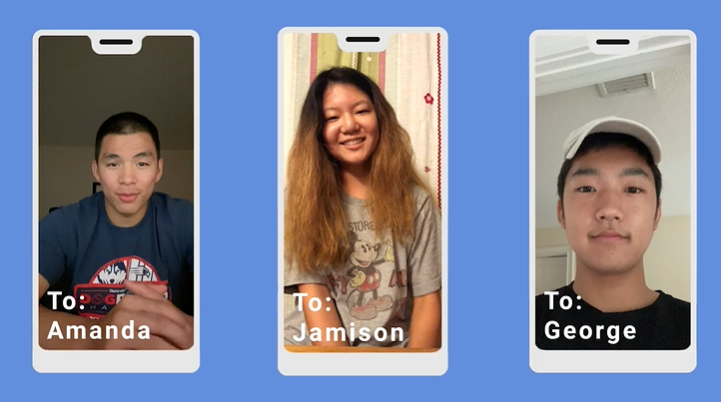
The Refreshr platform allows students to connect and share supportive video greetings (via Refreshr.org).

Pandemic life for college students is overwhelming, challenging, and isolating.

Two UConn students, though, wanted to help their peers build supportive connections during this time of uncertainty and physical distancing, and they’re doing so with the creation of an online platform,Refreshr.

“With mental health, it’s sometimes hard for students to support each other,” says Alex Kim ’22 (BUS), who co-founded Refreshr with friend, Jamison Cote ’22 (SFA). “Last semester was definitely just weird, and unprecedented, and crazy. Entering this semester and the coming semesters, it’s still going to be different – it’s a new way, how we learn and how we interact with other people. With such a drastic change, we still need to be able to be resilient as students and to be able to support each other, because we’re going to need it the most, especially during a time like this.”

Like pen-pals for the Internet age, Refreshr works to match students with each other and then helps them to record a video message specifically for their partner and use Refreshr’s one-way video sharing platform to send their words of encouragement. While most of the platform’s current participants are also UConn students, their goal, Kim says, is to connect a diverse group of students from institutions across the country that can form lasting connections.

“We wanted to make this a platform where students can send videos with uplifting messages of support and positivity to other college students,” says Kim, “to hear from students like you who are going through the same struggles of being in college during coronavirus. With Refreshr, we’re trying to build a community of students supporting each other.”

The idea for Refreshr, says Kim, came while he and Cote were enrolled in “The Entrepreneurial Journey,” a course taught by David Noble, associate professor anddirector of the Peter J. Werth Institute for Entrepreneurship and Innovation, and was modeled after their mentor, Noah Friedman, and his similar6FTCloser project. The platform launched in early September, and Kim says they hope their focus on college students will help promote well-being amongst their peers.

“Everyone needs to take care of their mental well-being because these struggles can happen to really, really anyone,” he says. “I think coronavirus has really showed the impact of being isolated from other people and just the difficulty of the circumstances that are now placed upon us as students.”

Kim says thatlearning about entrepreneurship at UConn, and seeing the work of fellow students who are starting businesses or developing new innovations, inspired him to take this initiative and to try to make meaningful change. He says that other students with an idea shouldn’t be afraid to take a chance and try to make something of it.

He also said that he hopes fellow students who are experiencing difficulties during the pandemic will seek out help, connection, and community – and know that they’re not alone.

“There’s lots of students who can resonate with the fact that it’s going to be a difficult semester,” Kim says, “so I hope there’s some at peace with that, and just hope you get the support and encouragement that you need.”

To learn more about Refreshr, visitrefreshr.org.


See original story via UConn Today at: https://today.uconn.edu/2020/10/student-launched-platform-supporting-mental-well-positive-messages-peers/