Month: May 2026

(Via UConn Today) UConn Alum Directs Public Service Announcement on Racial Profiling

UConn Alum Directs Public Service Announcement on Racial Profiling

A new campaign supported by UConn’s Institute for Municipal and Regional Policy advances statewide outreach on racial profiling while giving alum Matt Johnson ’25 (SFA) his directorial debut.

A driver grips the steering wheel while looking in the rearview mirror at flashing police lights during a traffic stop.
A new public service announcement for the Connecticut Racial Profiling Prohibition Project is designed to help viewers understand statewide efforts to improve traffic safety and eliminate racial profiling. (Photo courtesy of the UConn Institute for Municipal and Regional Policy)

A new public service announcement from UConn’sInstitute for Municipal and Regional Policy (IMRP)is turning a complex policy issue into a clear message for the public, while also providing a recent alum with his directorial debut.

Created for theConnecticut Racial Profiling Prohibition Project (CTRP3), the 60-second video is designed to help viewers understand statewide efforts to improve traffic safety and eliminate racial profiling.

Behind that brief message was more than six months of production work, as well as a professional milestone for Matt Johnson ’25 (SFA), an Old Saybrook native and graduate who directed the spot.

“It felt like a big stepping stone,” says Johnson. “It was real work, not just a school project, but still connected to UConn.”

“It was exciting to support a recent UConn graduate at the beginning of his professional filmmaking career,” saysKen Barone, project manager for CTRP3 and associate director of IMRP, which is part of UConn’s School of Public Policy in the College of Liberal Arts and Sciences. “I am confident that his work will continue to make a difference as he uses his skills to inspire these thoughtful conversations.”

CTRP3 is a statewide advisory board that oversees implementation of the Alvin W. Penn Racial Profiling Prohibition Act, which prohibits racial profiling by police. Led by Barone, the initiative examines traffic-stop data and works to promote transparency, accountability, and trust between law enforcement and the communities they serve.

While the subject matter is complex, the goal of the public service announcement is straightforward: to communicate clearly, concisely, and in a way that resonates with a broad audience. Viewers are directed to the project’s website, where they canlearn about the lawandhow to file a reportif they believe they have been racially profiled during a traffic stop.

In hiring a visual storyteller for this project, IMRP drew from an internal pipeline.Justin Liberman, assistant professor of digital media and design in the School of Fine Arts, connected the Institute with students from his narrative production class. Among them was Matt Johnson, whom Liberman recognized for both his technical ability and his readiness to take on a larger role.

“I hadn’t heard of the IMRP or CTRP3 before the first call,” says Johnson. “But with video, you get thrown into these projects, and it’s your job to figure out how to communicate them.”

That challenge quickly became part of the appeal.

Johnson had been producing his own content since high school and came to UConn hoping to capitalize on its strong program and local connections. He earned his degree in just three years and was ready to put his skills to work.

The project came at a pivotal moment, just as Johnson was transitioning from student to professional. For the first time, Johnson was managing a full production with a budget, coordinating a team, and navigating the expectations of multiple stakeholders. He also edited and created graphics and scored music for the video.

“It wasn’t just making a video. It was running a production,” Johnson says. “I’d never done a project on this scale with fiscal responsibility. Figuring that out was huge.”

From concept through final editing, the public service announcement was developed through close collaboration between Johnson and IMRP staff, with script input from the project’s advisory board.

That collaboration helped ensure that the message was both accurate and effective, particularly given the complexity of the topic. At the same time, it required translating creative ideas into terms accessible to partners less familiar with video production and securing and maintaining buy-in on the concept.

“It was a huge awakening,” Johnson says of the script meetings. “Understanding how people feel in those traffic-stop situations was something I hadn’t experienced before. I wanted to be sure to represent those experiences thoughtfully and accurately.”

The resulting video captures the power of perspective, says Barone.

“By centering each person’s lived experience, the video reminds us how important it is to listen, understand, and find common ground,” says Barone.

A man behind a camera gestures while directing a video shoot.
Matt Johnson ’25 (SFA) directs a scene at the UConn Hartford campus. (Photo courtesy of the UConn Institute for Municipal and Regional Policy)

The connections to IMRP and the CTRP3 advisory board helped bring that authenticity to the video. While Johnson hired an actor to portray a driver, a real-life officer from the Madison Police Department played the role of the on-scene officer. Local police also supported the shoot and helped ensure the safety of the crew during the roadway scene.

Filming took place outdoors and at UConn Hartford, where IMRP is housed, as well as the offices of West Hartford Chief of Police Vernon Riddick.

Several UConn contributors appear on-screen, including Barone, IMRP program administrator Erica Escobar, and Anya McGlaughlin, an IMRP research intern and School of Public Policy master’s candidate.

For Johnson, who had often worked independently or with fellow students and classmates, the experience of supervising a six-person crew marked a shift.

“Having a full team, that was huge for me,” says Johnson. “It changes what you’re able to create.”

IMRP has contracted Johnson to create a second CTRP3 outreach video and another featuring the community forums it runs around the state. He will add that to his busy post-graduate schedule.

In addition to running his own media company, Matt Johnson Media, he works part time as a video specialist with Miranda Creative, shooting commercial and social content for a variety of clients.

“I want to be part of projects at this level full time,” he says. “I want to be the one shaping what people see on screen.”

For IMRP, the collaboration reflects an ongoing effort to expand how its work is communicated and who helps tell those stories.

“This project showed what’s possible,” Johnson says. “When you bring together the right people, you can create something that really connects.”

Article at UConn Today: https://today.uconn.edu/2026/05/uconn-alum-directs-public-service-announcement-on-racial-profiling/ 
(Via UConn Today) Senior Exhibition and Film Festival Highlight DMD Capstone Projects

Senior Exhibition and Film Festival Highlight DMD Capstone Projects

The exhibition brings together works from DMD disciplines ranging from animation to interactive design to video production, showcasing the talented Class of 2026

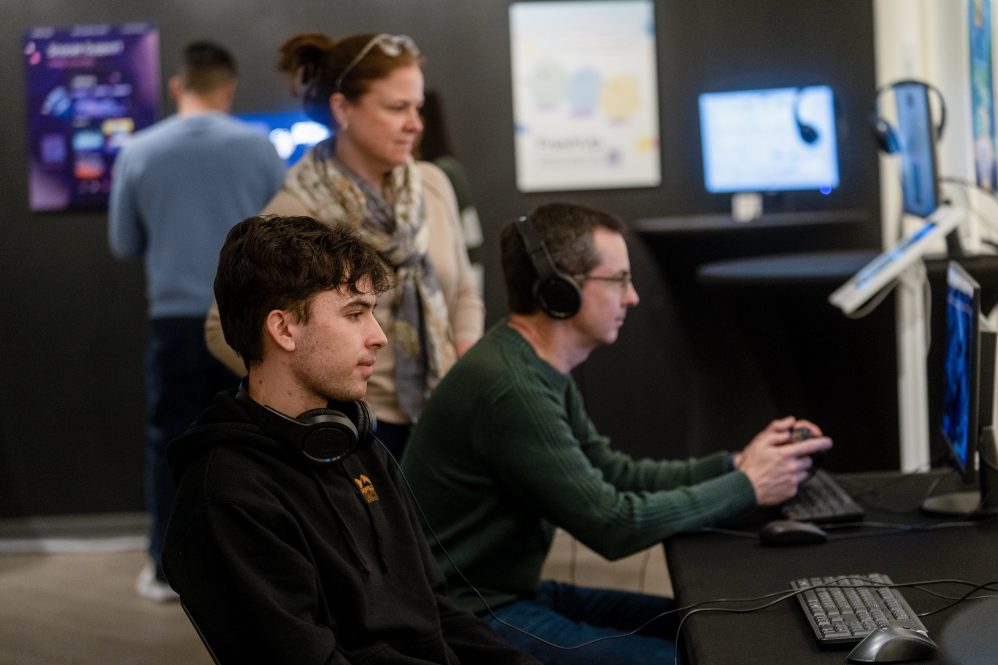
Two men sit at desktop computers playing video games.
Audiences visit and engage with the DMD senior exhibition projects displayed in Jorgensen Gallery. (Contributed Photo)

For the past year, 59 digital media and design (DMD) seniors were devoted to developing their senior capstone projects. Their efforts culminated in the 8th annual UConn DMD BFA Senior Exhibition and the first ever Film & Animation Festival at UConn.

Hosted in the Jorgensen Gallery, the DMD exhibition featured the web and interactive media design as well as game design work of 28 students, and on April 25, 31 seniors participated in the film and animation festival at the Harriet S. Jorgensen Theatre.

“In the eight years since we started the exhibition, it nearly tripled in size. From 21 students in 2019 to 59 now, is an incredible growth,” says Heather Elliott-Famularo, the department head for digital media and design.

The two-semester senior capstone course allows students to gain professional experience in their field as well as executing skills they’ve spent the past four years developing.

“Taking the time to experience the whole process of game development was essential in expanding my skillset going forward. While I’ve developed projects throughout my time at UConn, this was my first time making something fully complete to publish, so spending time on optimization and being prepared for this to work on other devices was an immense learning experience,” says Ryan DeFillipo ’26 (SFA), whose video game “May Our Paths Cross” was featured in the exhibition.

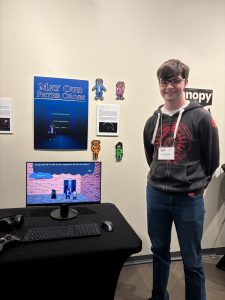
A boy poses in front of a display of his video game on a computer.
Ryan DeFillipo with his exhibition, a video game called “May Our Paths Cross.” (Contributed Photo)

The various concentrations within the DMD program offers students the flexibility to create a project they are passionate about, while also providing the opportunity to dive into the different areas of their creation.

“I chose DMD because it offered me mobility, not just forced into one major or the other, like a lot of other Digital Media programs, especially because at the time, I was unsure which medium I wanted to tell stories in,” says Connor Denecour ’26 (SFA), who found his passion for telling stories that have been underrepresented through film, culminating in his capstone film “Running Against the Odds.”

A unique element of this project for the interactive game students is that they are doing all the aspects needed to install their work for the public, a vastly different process than creating work for a one-time critique.

“I spent lots of time solving code, creating artwork and rewriting scripts. I designed every component used in the project, which was an incredible learning experience but also time-consuming,” says DeFillipo, whose game takes experiences from his life to resonate with others. “For over 30 weeks, I spent hours designing and implementing assets, receiving feedback and then applying that to my work. Over that repetitive process, my game took shape.”

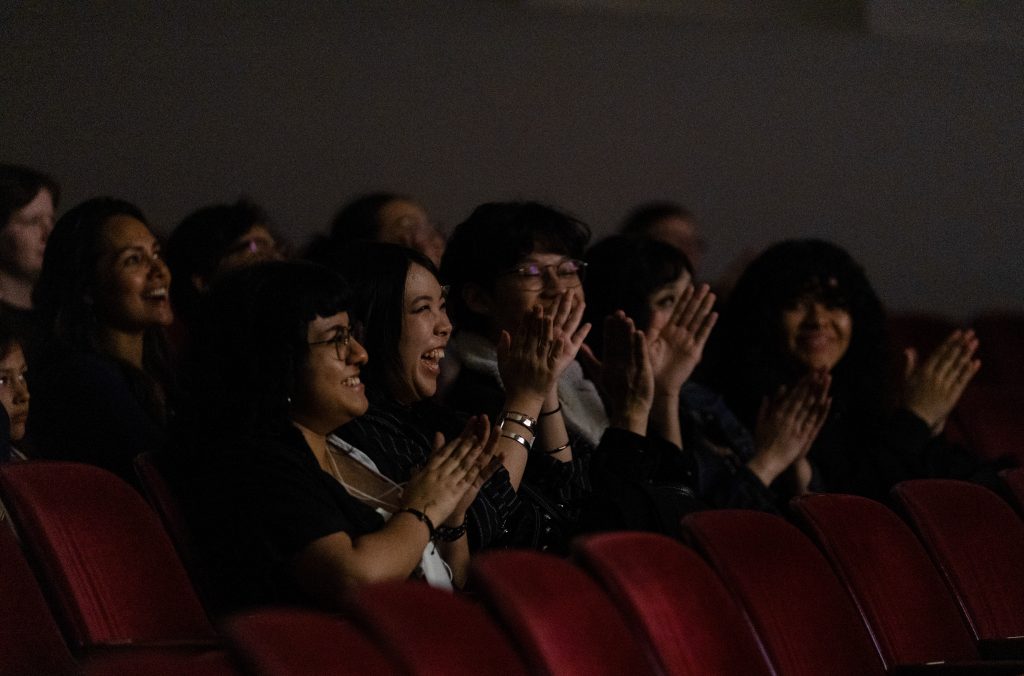
Row of people in a theatre clapping.
Audience members during the film and festival on April 25, 2026. (Contributed Photo)
The nature of the DMD program is a close-knit and collaborative community. This support is reflective in the capstone project through student cohorts and faculty mentoring.

“My project advisor, James Coltrain, started working with me back in May of 2025 to ideate, and give early feedback on prototypes, mechanics and artwork. From there, I shared my progress with my friends in the major, who’ve been an amazing support group over the last four years, to receive constructive feedback,” says DeFillipo.

Every student selects one faculty to be a DMD senior project advisor who they meet with throughout the year. This structure is designed in a way to help support the students to get the most kind of feedback and improve their projects during the whole experience, explains Elliott-Famularo.

For Denecour, his classmates even ended up being part of his film crew, helping him tell the story of Ellison “Tarzan” Brown, a Narragansett Indigenous runner who competed during the Great Depression.

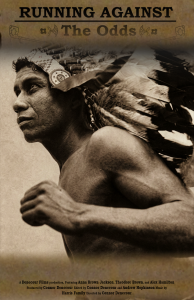
A documentary poster featuring the main character in black and white.
Connor Denecour’s poster for his exhibition film, “Running Against the Odds.”

The exhibition and film festival not only celebrated the work of DMD seniors, but also emphasized the creative freedom that the DMD program offers.

“We really encourage students to find a topic they’re passionate about, which shines through in these final projects. Our program is not forcing our students down a certain path, but rather helping them find their creative voice,” says Elliott-Famularo.

For DeFillipo and Denecour, their personal passions and digital skillsets flourished through their capstone project, preparing them for a future in digital creation.

“Going into the gallery during the exhibition showcase to see people playing my game was a dream come true and knowing that they could enjoy what I put my heart into for the last year and change was incredible,” says DeFillipo, who plans on continuing growing his skillset to make more projects, and share them with others.

After sharing his film with an audience, Denecour is looking forward to submitting his work to local film festivals and continuing to share Tarzan’s story.

“Having my work shown was a very touching experience. I am super critical of my work, and when working with the community, I wanted the piece to be the best it could be. When it was playing, I heard people seriously engaging with the film, reacting to the highs and lows of Tarzan’s life. I felt that the film did what it was meant to do: getting Tarzan’s story out there past Rhode Island and Eastern Connecticut,” says Denecour.

UConn Today: https://today.uconn.edu/2026/05/eighth-annual-senior-exhibition-highlights-dmd-capstone-projects/